


What is Auto-Refill?
Our product subscription program
You can now dial in how frequently you'd like us to send your favorite blend, and let automation take care of it all. Super easy, you never have to think about it, and you're just done.
Special pricing
Get an immediate 20% off without ever using a coupon code again.
Set it and forget it
Easily manage what you receive, and when it arrives. Cancel anytime.
A home for your matcha
Receive a complimentary German-made black-violet glass jar that is ideal for matcha storage.
Need a Jar?
The jar is important
Matcha is happiest and remains the most vibrant stored in black-violet glass. We count on you to store your matcha properly, so please let us send you a jar if you do not have one.
For 30g new customers
We'll include a free small jar.
For 30g returning customers
If you already have a jar and do not need another, select "This is a refill." Otherwise we'll send it in a jar.
For 100g, 250g, 500g + 1kg customers
We offer medium and large jars in the cart and highly recommend you get one. Subsequent orders ship in a refill bag that you'll empty into your jar.
For subscribers
The initial order ships with a free jar, and subsequent orders ship in a refill bag that you'll empty into your jar.
What's a serving?
One gram (1g) of matcha is a serving.
It's what we base all our nutritional analysis on. By volume 1g is a rounded half-teaspoon. A gram of matcha combined with 2 to 3 ounces of hot water is a serving.
Making a larger or thicker cup.
If you'd like a larger or thicker cup of matcha, just double it to 2 grams. Some people even use 3, and the really committed matcha people like 5 or 6. Experiment, and prepare it as strong or as weak as you like it.
Larger sizes = lower cost per serving.
If you're a regular drinker, the most economical way is to purchase larger sizes because the cost of a serving lowers. Matcha will keep well for a few years in the fridge, so no worries about it losing potency or vibrancy.
Why do people like our matcha so much?
The matcha world is confusing! For many folks, the sweet milkshake-ish matcha from coffee chains is the only matcha they know. But the matcha you see here is very different.
Drinking good matcha for the first time is a little like your first great cup of coffee, and like your first great wine experience, in one. You weren't quite expecting how good it actually tasted, given your previous experience. But there's a moment when something clicks, and your brain says, "yes, please, you definitely need this!"
“...Elegant, soothing, dreamy ... hints of chocolate, lingering dreamy aftertaste, no bitterness--Love it. I refuse to drink Matcha unless it's from Breakaway.” – Christine
Unlocking the Mystery
Preparing matcha isn't like steeping a tea bag, so it might seem mysterious. With regular tea you steep it, throw away the tea, and drink the extract. Quality matcha is 100% green tea leaves, but they are ground into a fine powder using traditional granite grinding stones. You scoop some into a cup or bowl, add water (cold or hot) and then whisk it into a frothy brew. The powdery tea leaves get suspended in the water, long enough for you to consume it, leaves and all. Because you're drinking the entire plant, and not just the extract, it has a very different metabolic effect. Most of the really good health properties of matcha are found in the insoluble fibers of the tea, giving you all the tea’s many health benefits.
Obsessed (For 20 Generations)
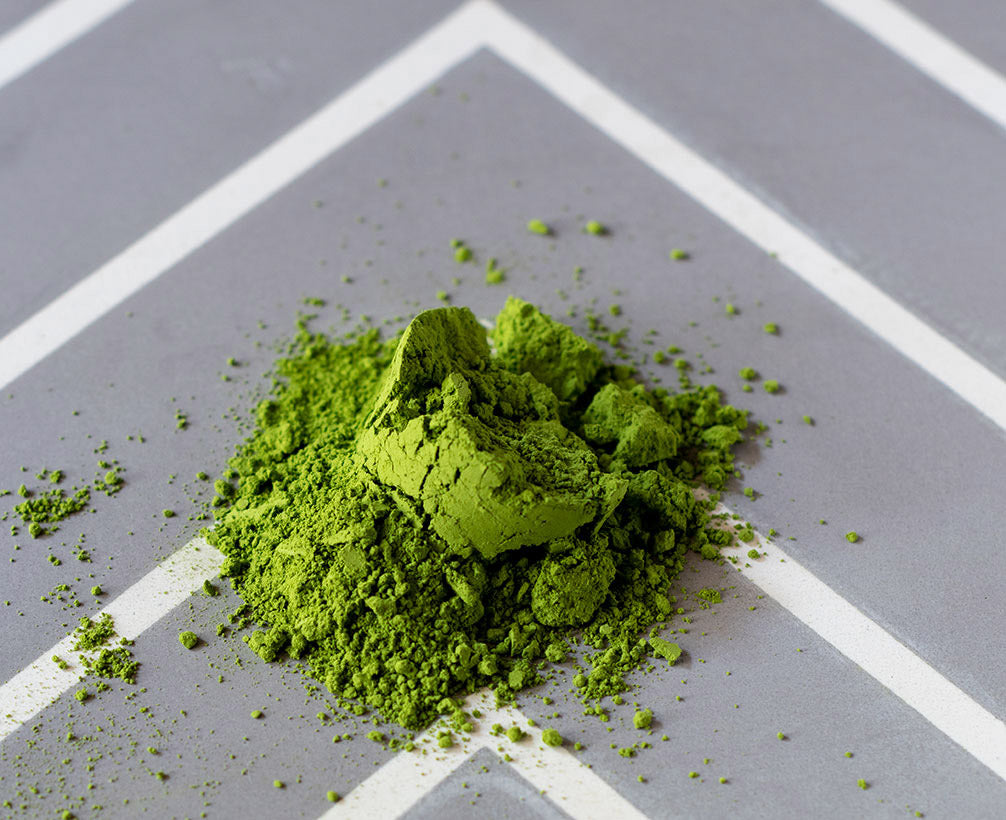
Quality matters with almost everything, but it really matters with matcha. It's why we’ve been so picky when it comes to identifying growers who care the most. We believe we've identified the highest quality growers doing matcha anywhere in Japan. Most are clustered around Kyoto, in a place called Uji; and premium matcha is what they do there. Some farms go back 20 generations -- that’s more than 600 years of tea cultivation. And over 600 years of obsession. They're infatuated with this beautiful plant, and so are we. While we do offer culinary grades of matcha for culinary purposes and for lattes, it's the higher, hyprepremium grades we're best known for. It's relatively expensive because it's the hardest to make; it’s very time intensive, labor intensive, and knowledge intensive … but all of our matcha embodies the five tell-tale signs of a great matcha: maximum umami, an electric green color (it almost looks fake), intoxicating vegetal aroma, creamy frothability (achieved through traditional granite grinding mills), and a long, stunning finish.
Discriminating. For a Reason
We've identified 18 matcha that meet our standards for truly great matcha. We constantly get pitched to try various matcha, but the bar is set very high. We’ve never deviated from these sky-high standards. Our earliest clients include all four of California's three-Michelin-starred restaurants (The French Laundry, Benu, Atelier Crenn, and Single Thread), which are among the most lauded restaurants in the world.
On Your Own Terms
There’s far too much pressure to buy now, act now! Please don’t feel rushed. We aren’t going anywhere. Whenever you're ready -- and only when you're ready.
Breakaway Promise
We stand behind our teas and teaware, and want you to be not just satisfied with them, but thrilled. If for any reason you're not, just let us know and we'll do our best to make it right.
Your Questions Answered
Mainly because the farmers and processors care so much; their processes take longer, require more steps, and are just harder. They’re pretty obsessed with producing Japan’s tastiest and healthiest matcha, and we don’t mind paying them well for the extraordinary product they produce. Rarity comes into it as well -- some blends, especially the named blends (Kamakura, Rikyu, Jizo, Hikari, Satoshi, and Daphne) have extremely limited production. These teas are hard to produce.
No. No sugar, additives, or any other nonsense. It’s 100% extraordinary green tea leaves, ground up into a fine powder.
Location on the tea plant, mainly. Hyperpremium is the baby leaves; we only use the newest growth. Imagine baby vegetables, baby herbs, microgreens. They haven’t had much time to develop much molecular complexity, so there are no bitter or astringent notes, just clean, chlorophyll-packed umami.
Leaves used for coldbrew are slightly older, and have a little more biocomplexity to them. That complexity does add some bitterness and astringency, but it’s undetectable when prepared with ice water, so it tastes rich and creamy. Yields are tiny for the hyperpremium, and yields are bigger with coldbrew (the leaves themselves weigh more, and are larger, hence bigger yields).
This term has lost most of its meaning. Because there is no governing body of any type that monitors/controls what can be labeled ceremonial, anyone can -- and does -- use this moniker to connote quality, even though much of the “ceremonial” matcha on the marketplace is in fact barely culinary -- much of it could be better described as “industrial.”
Moreover, many tea ceremonies in Japan notoriously serve sub-par matcha. In the end, many of the ceremonies aren’t really about tea at all, they’re about choreography and pedigree. Sometimes the teas are tasty, but more often they’re oxidized and bitter and astringent; hallmarks of culinary (or worse) matcha.
Some people insist on organic (generally for good reasons), so we searched hard for years and finally found what we feel is the tastiest and best organic matcha in the domestic Japanese market. However, our conventionally grown matcha is utterly safe, and it tends to taste better because its umami/amino acid structure is more pronounced.
Recommended For You



Froth up your inbox
Tea-fueled inspiration to help you create pauses and meaning.